

This was originally published by Corporate Europe Observatory.
——————————————————————————————-
As climate negotiators returned home from the failure of COP31 in Türkiye in November 2026, Europe remained the fastest-warming continent. And while ordinary people are paying the price of the escalating climate and cost-of-living crises, the fossil fuel industry and its allies continue to find new ways to protect and expand their profits.
Their newest quest is gas-powered data centres. Following a heavy lobby by Big Tech and its allies in the fossil fuel industry, the EU is planning a massive expansion of energy-hungry data centres across Europe. The target is to triple current data centre capacity in five to seven years.
If this expansion goes ahead, it will drive up people’s energy bills, worsen the climate emergency and deepen Europe’s dependence on volatile and expensive gas imports. Instead of prioritising affordable, reliable renewable energy and ensuring it serves people’s needs, the EU is gearing towards an energy system serving the demands of Big Tech – and the interests of Big Oil.
Data centres: a new escape hatch for the gas industry
Big Tech giants such as Microsoft and Google are increasingly teaming up with oil and gas companies including ExxonMobil, Chevron and Eni. Whether it’s greenwashing fossil-fuelled data centres, or developing shared narratives and joint lobbying, Big Tech and Big Oil are forming a dangerous alliance.
The rapid expansion of data centres is driving up demand for fossil gas and encouraging investment in new fossil fuel infrastructure. According to the International Energy Agency (IEA), investment in gas reached a 25-year high in 2025, driven mainly by the data centre boom.
At the same time, Big Oil and Big Tech are working together to greenwash this expansion by promising that data centres will eventually run on ‘clean’ energy.
For Big Tech, these claims provide a convenient justification for building more data centres now, while promising decarbonisation later. For Big Oil, the data centre boom creates new opportunities to promote its favourite false solutions, including carbon capture and storage and hydrogen. Both are being presented as ways to reconcile continued fossil fuel use with climate targets, despite their track record of failure and the risk of locking Europe into fossil fuel infrastructure for decades.
The result? Big Tech gets the dirty energy it needs to expand, while the fossil fuel industry secures new markets and a fresh justification for continued investment in gas.
Data centres vs people and planet
Data centres consume enormous amounts of electricity and water. Across Europe, their rapid expansion is already raising serious questions about who benefits and who bears the costs.
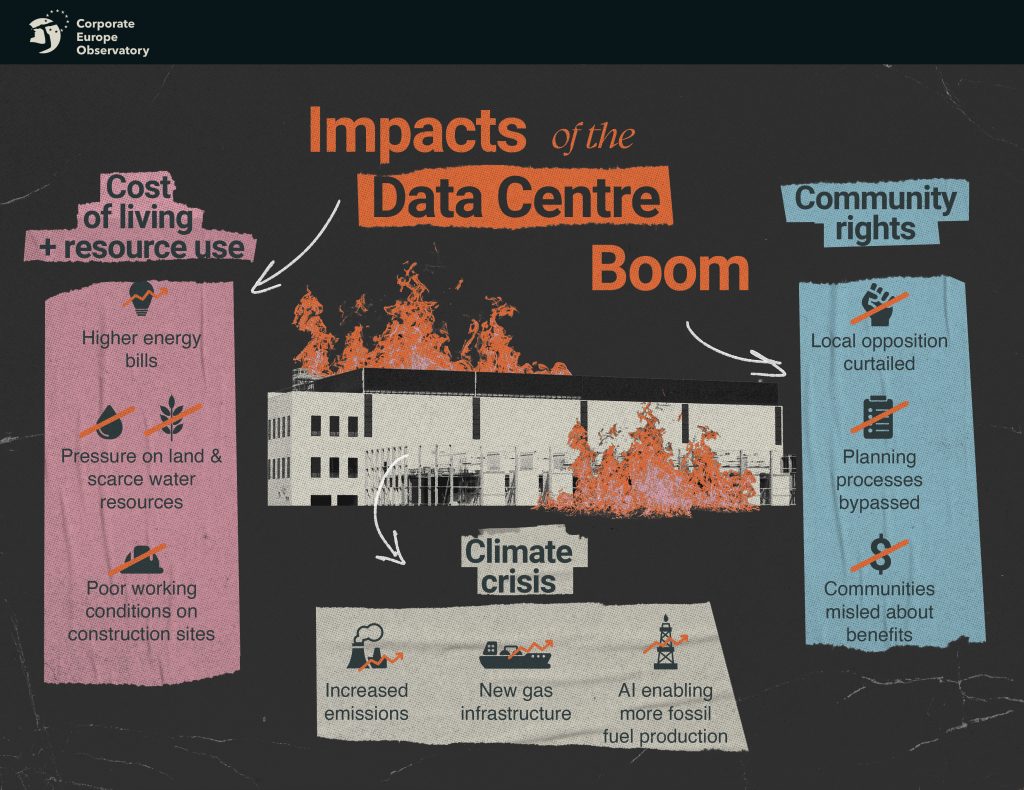
The vast amounts of energy required for the expansion of data centres is outpacing growth in renewable energy. Consequently, new facilities increasing rely on fossil fuels.
Data centres’ vast energy demands are also resulting in the building of new infrastructure to power them: from gas-fired power plants to LNG terminals importing US fracked gas. This infrastructure creates long-term fossil fuel dependency and locks in emissions for decades.
Even when data centres are powered from the grid, their huge electricity needs are preventing other industries from electrifying, with the result that more fossil fuels are kept in the energy mix. For example, in Ireland, the Netherlands, and Denmark, the data centre build-out has become an obstacle to the electrification of transport. Denmark has now introduced measures to deprioritise data centres for grid access.
The climate impacts of data centres don’t stop there. AI models trained and hosted in data centres are being sold by Big Tech to Big Oil to increase oil and gas yields, pushing the climate to breaking point. For example, the use of Microsoft AI to increase production at one of Chevron’s oil fields led to additional emissions of over 50 million metric tons of CO₂ a year – more than 20 times the amount of CO2 produced by Microsoft’s largest data centre. A recent study suggests that AI’s role in increasing emissions from boosting fossil fuel production far outweighs any climate benefits that AI applications in renewables might have. This is known as ‘enabled emissions’.
The impacts of data centres on people, meanwhile, are already being felt in other ways.
In Ireland, the country’s 129 data centres account for almost a quarter of national electricity demand. Data centre operators pay around half the electricity price paid by households, while local communities face growing difficulties accessing the electricity grid.
Working conditions are another concern. A recent investigation led by Investigate Europe revealed appalling working conditions in data centre construction sites across Sweden, Norway, Belgium and the Netherlands.
And as the EU moves to accelerate data centre construction, it is also considering measures that will make it harder for communities to challenge projects, defend their rights and have a meaningful say in decisions affecting their lives.
Dirty Energy and the data centre lobbying offensive
Earlier this month, Corporate Europe Observatory and SOMO revealed the Big Tech lobby campaign to ease data centre permits in the EU. Lobby meetings on EU data centre polices in the run-up to the Cloud and AI Development Act (CADA) were heavily dominated by corporate interests – and the resulting Act, proposed by the Commission in June 2026, prioritised speed over sustainability safeguards.
Although the lobby offensive on CADA was dominated by Big Tech companies and data centre operators, digging into the data showed that the fossil fuel industry’s fingerprints were also present.
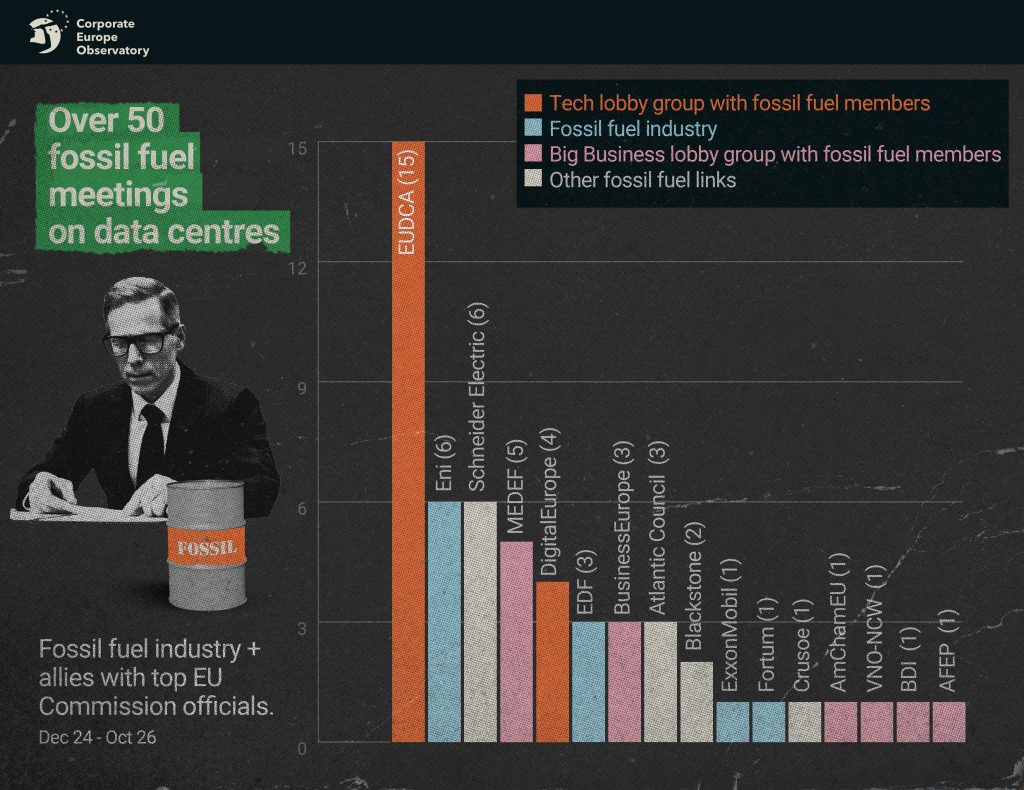
The 160 entities holding meetings on the CADA included fossil fuel companies like Italian oil and gas producer Eni and energy giants with fossil fuel power plants like EDF and Fortum.
It also featured big business lobby groups with fossil fuel companies on their boards or as members, such as BusinessEurope, France’s MEDEF, Germany’s BDI, the Dutch VNO-NCW and the AmChamEU from the US.
Other types of organisations with links to the fossil fuel industry also held meetings on CADA, including the Atlantic Council, a think tank whose International Advisory Board features Eni, Repsol and Crescent Petroleum. Companies that work with oil and gas corporations, like Schneider Electric – a proponent of using AI to more efficiently extract fossil fuels as well as a supplier to Big Tech hyperscalers and a vocal lobbyist for “accelerated permitting” for data centres – were also engaged in the lobby.
Tech lobby groups with fossil fuel connections should also not be ignored. The European Data Centre Association (EUDCA)’s membership not only includes Big Tech titans like Google, Microsoft and Meta, but also companies with fossil fuel interests such as gas supplier Octopus Energy and Mitsubishi Heavy Industries. The latter builds oil and gas production plants and sells turbines for gas power plants – including ‘Hydrogen-Ready Gas Turbines’ as a ‘CO2-Free Power Supply’ solution for data centres. The hydrogen lobby is jumping on the bandwagon of the data centre boom,asking for joint planning of hydrogen infrastructure and data centre growth. This ignores the dirty truth behind hydrogen, which includes the fact fossil-based hydrogen – called low-carbon by the industry – has a climate footprint that exceeds the direct burning of fossil fuels.
To reveal the extent of the fossil fuel industry’s fingerprints on data centre lobbying, we took a deeper dive into lobby meetings with, or linked to, the fossil fuel industry. Examining data related to meetings up to the end of October 2026, and looking into minutes as well as meeting topics, we found a total of at least 54 top-level Commission meetings relating to data centres and AI infrastructure with the fossil fuel industry and its allies.[1]
These included yet another Big Tech lobby group with fossil fuel participants: DigitalEurope, whose members include Greek fossil fuel company Motor Oil and gas turbine producer Siemens Energy. ExxonMobil also popped up, holding a meeting whose minutes revealed that data centres were discussed. However the fossil fuel company that racked up the most frequent meetings with the Commission around this topic was, without question, Italian oil major Eni.
Spotlight on ENI
In Italy, Eni proposes that new gas-powered data centres be equipped with carbon capture and storage – a fossil fuel industry escape hatch that is being used to justify and greenwash the expansion of gas.
By re-branding fossil gas power for data centres as ‘blue power’ – with the claim that the CO2 from burning fossil gas will be captured and stored – Eni has leapt on the data centre boom as the newest lifeline for the climate-wrecking fossil fuel industry.
But fossil fuel companies have been promising and failing to deliver carbon capture and storage technology for decades, at great public expense. Globally, we’re ‘permanently’ burying less CO2 than a single large power plant can emit in a year – and the scientific evidence underpinning the idea of ‘permanent storage’ has been exposed as flimsy, at best.
Despite the dangers, cost and history of failure, Eni and other oil giants like ExxonMobil are presenting carbon capture to policymakers as a get-out-of-jail-free card for dirty developments like data centres. Between December 2024 and October 2026, Eni held at least six lobby meetings with high-level Commission officials relating to AI and data centres.[2]
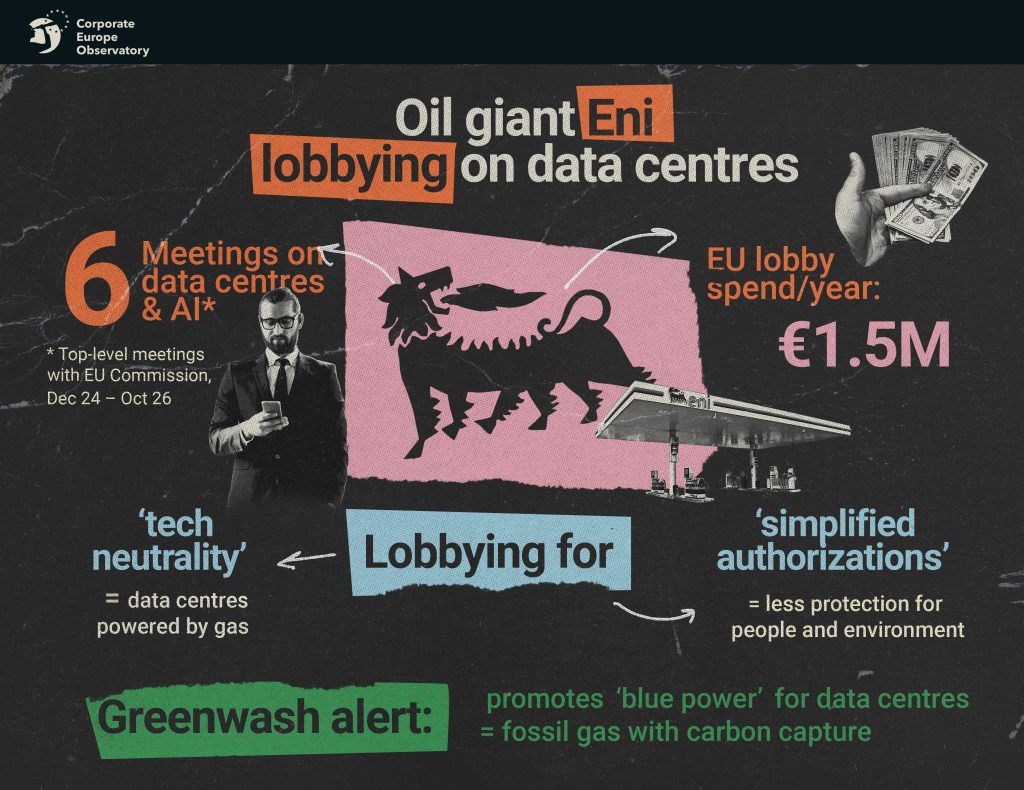
Eni has been pushing for the EU’s data centre policy to:
- Be ‘technology neutral’: Eni has made no secret that it thinks fossil fuels should supply data centres – but it wraps its dirty energy vision in a long-time greenwashing ploy: the use of fossil gas with carbon capture and storage. In its lobbying of the Commission, it has pushed for CADA to “be grounded in the principle of technological neutrality” that puts “carbon management strategies” (read: gas with the promise of captured emissions) on an “equal footing” with renewables.
- Introduce ‘simplified authorisation’ procedures for data centres: Eni said CADAshould include simpler authorisations and a formal recognition of the ‘strategic’ nature of data centres. Simplified rules or loopholes for ‘strategic’ projects will, in reality, remove vital protections for communities and nature, in effect giving carte blanche for the spread of energy-guzzling data centres across Europe.
- Be written hand-in-hand with industry: Eni emphasises the importance of stakeholder engagement “with industrial actors, energy players and infrastructure providers”. Affected communities, environmental organisations and trade unions are notably absent from their list of “particularly” important stakeholders.
Lobbying demands on data centres explained
The demands of Big Tech and their dirty energy allies have been picked up by the Commission in its proposed Cloud and AI Development Act (CADA). Industry asks are consistent: make it easier and faster to build data centres, remove environmental and social safeguards, limit the ability of communities to challenge projects, and avoid binding requirements to improve environmental performance.
But what does this mean in practice?
Faster and simpler permitting: weakening safeguards
Industry lobbyists want the EU to simplify and accelerate permitting procedures for data centres. Take French energy company EDF, which argues that EU environmental regulations should be ‘streamlined’ to facilitate the construction of data centre facilities across the EU. But these planning and environmental rules are not superfluous red tape. They exist to protect communities, workers, nature and the environment. Weakening or removing them will undermine these protections.
Data centre acceleration zones: creating sacrifice zones for Big Tech
Industry lobby groups like BDI, the German industry association whose board includes oil and gas firm Harbour Energy, have called for “Data Centre Acceleration Zones, strategic project status and shorter permitting procedures”. Under the CADA proposal, data centre acceleration zones would give projects a privileged status and fast-track their permit process, with a 12-month limit for obtaining all permits. If the proposal is adopted unchanged, EU Member States would be required to designate such zones.
These zones would prioritise corporate investment over the rights and interests of people living in affected areas, thereby speeding up the transformation of communities into sacrifice zones.
Overriding public interest: putting corporate projects above environmental protection
A pervasive industry demand – including from coal- and gas-fired power plant operator EDF – has been to give data centres the status of “overriding public interest”. This would make it easier for projects to benefit from exemptions to environmental protections and to take precedence over competing public interests.
The Environment Omnibus proposal to speed up environmental assessments, which is still being negotiated, includes a ‘strategic’ project status that bestows the presumption of ‘public interest’. This gives such projects special treatment, including access to fast-tracked dispute settlement. A similar ‘strategic’ label for data centres in Aragón, Spain has allowed tech firms to benefit from faster land expropriation procedures and tax breaks.
Projects in CADA’s Data Centre Acceleration Zones would benefit from this ‘strategic’ status: the associated public interest presumption and all the environmental and democratic loopholes it provides.
Restricting the rights of affected communities: silencing opposition
Industry lobbyists have also been seeking to restrict the rights of impacted communities. Their proposals would make it harder for people to object to projects, access legal remedies or hold companies and public authorities accountable.
Google, for example, has explicitly asked the European Commission to severely restrict the right to appeal data centre projects. The company called for the legal right to object to be limited to “immediate neighbours and only during the zoning process”. Google pointed to Austria, where permits can be legally challenged only by people living within 50 metres of a project. Google also suggested that to address community protests, governments should “do a more effective job at conveying the vital importance of data centres to communities and the economy”.
No binding environmental performance standards: free ride for corporations
Over the past year, Big Tech and its allies, including groups like EUDCA, have successfully lobbied against stronger environmental requirements for data centres, including in discussions around the EU’s data centre energy rating scheme. Together with AlgorithmWatch and InvestigateEurope, CEO exposed how the EU Commission copy-pasted an amendment suggested by Microsoft and DigitalEurope to keep environmental data secret.
Now, industry lobbyists want to prevent the CADA proposal from introducing further environmental criteria, particularly binding minimum performance standards. Even when couched in euphemistic terms, big business groups have made their disdain for strict environmental rules clear: French lobby group MEDEF, whose board includes TotalEnergies, for example, has lobbied for a “pragmatic approach to the challenge of natural resources” to support “the deployment of data centre capacity”.
Big Tech and Big Oil take their message to COP31
The same fossil fuel and Big Tech companies that have been lobbying the EU to prioritise their interests in the CADA data centre law were well represented at the COP31 climate talks in the Turkish city of Antalya in November 2026.[3]
Eni, ExxonMobil, Fortum and EDF – fossil fuel companies that have all held lobby meetings with the European Commission on data centres – together had 22 participants at COP31.
Tech giants Microsoft, Amazon and Google, among the most prolific lobbyists on CADA (with a combined 41 Commission meetings prior to its publication), sent 25 representatives to the UN climate talks. At EU level, these tech firms also have a history of joint lobbying with fossil fuel companies.[4]
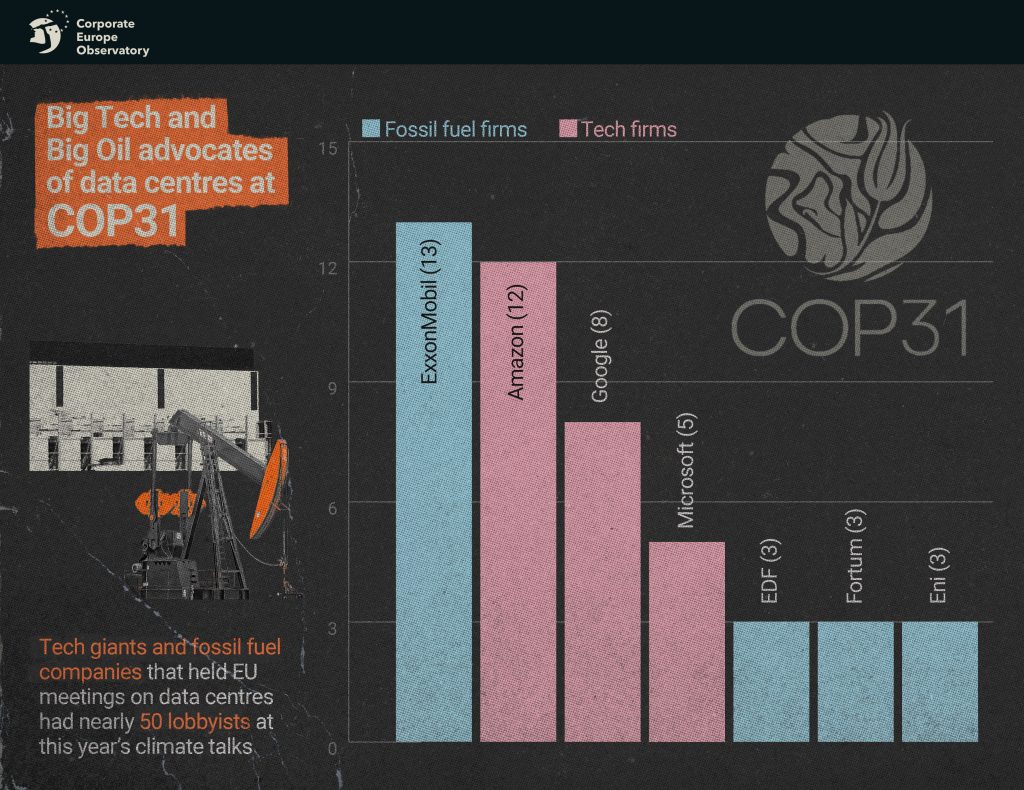
With 47 participants at COP31, these Big Tech and fossil fuel firms are all set to follow a well-greased Big Oil playbook: to attend the UN climate talks to greenwash their activities, and to co-opt and redirect global climate action to protect their business models – no matter the cost to people and planet.
ExxonMobil had a staggering 13 participants at COP31, including six as ‘host country guests’. The co-hosting countries were Türkiye and Australia.
EDF and Fortum had attendees in the official delegations of France and Finland, respectively, while Eni attended as part of Italy’s official delegation.[5] In addition to Eni’s three delegates,[6] Italy’s delegation included representatives of the World Energy Council Italy, whose President is from Eni, plus two foundations co-founded by Eni.[7] Separately, Fondazione Eni Enrico Mattei, a research foundation set up and largely funded by Eni, sent two participants to COP31.
Amazon sent a total of 12 participants, all in non-governmental delegations such as big business associations and oil and gas lobby groups. These included:
- The US Chamber of Commerce and the International Chamber of Commerce, which both also provided badges to ExxonMobil;
- The Association of Oil, Gas and Renewable Energy Companies of Latin America and the Caribbean (ARPEL). This fossil fuel lobby group’s members include Shell, Chevron, Petrobras and Peru LNG. Its members, ARPEL notes, are responsible for producing 6 of every 10 barrels of oil in Latin America, and 2 out of 3 units of gas.
Google’s eight participants at this year’s climate talks attended as part of the delegations of Benin and Colombia,[8] while Microsoft’s five participants were either conference invitees or host country guests.
Just the tip of the iceberg?
These figures offer merely a glimpse into the total number of fossil fuel and data centre lobbyists who attended COP31. They only include companies that have also had top-level meetings on data centres with the EU Commission. But over the years, the number of lobbyists sent by Big Oil to COPs has been in the thousands, as documented by Kick Big Polluters Out. Meanwhile, Lighthouse Reports has calculated that the total number of data centre lobbyists at COP31 was closer to 500, twice as many as at last year’s talks, and including 50 from Big Tech.
COP31’s high-level political talks ended in collapse, with the EU and many others rejecting a text that omitted the phase out of fossil fuels. The bloc claimed it could not “endorse a decision that greenwashes fossil fuels”, yet a few days prior it had done exactly that, changing EU rules so that oil exploration could be labelled as a “green investment”. The hypocrisy was compounded by multiple EU member states including fossil fuel lobbyists in their delegations to COP31.
We know the messages that US tech firms and dirty energy corporations have been selling to EU policymakers around data centres: cut environmental protections and restrict people’s say when building them, keep their true impacts hidden, and even let fossil fuels power them.
Such messages are justified with the idea that ‘winning the AI race’ trumps all other considerations, and are shored up by unsubstantiated claims that ‘AI will solve the climate crisis’.
But AI is no climate saviour. The services provided by data centres are already being sold to fossil fuel companies to increase extraction. Big Tech’s hyperscale data centres are not just guzzling gas and electricity; the AI models they support are enabling additional fossil fuel emissions.
It is notable, therefore, that since COP30 in 2025, around half of all corporate engagement on climate-related policy issues that referenced AI and data centres contained pro-fossil fuel narratives, according to InfluenceMap research.
Unfortunately, the efforts of Big Oil and Big Tech to obfuscate their central role in the climate crisis by portraying themselves as part of the solution are paying off.
Just prior to COP31, its host Türkiye launched a voluntary AI climate pledge that has this narrative at its heart. The Antalya Artificial Intelligence Pledge asserts that AI helps the climate and can reduce greenhouse gas emissions, with a voluntary commitment to make sure the data centre build-out is sustainable (including actions that would achieve the opposite).
Such voluntary, self-regulation projects distract from the reality that data centres are draining our water resources, guzzling dirty energy and pushing up electricity prices. Furthermore, they are a misdirection from the evidence that AI is in fact doing far more harm to the climate than good.
Putting people over polluters
Beyond their severe impacts on communities, people’s livelihoods and the climate, the data centre boom exposes a deeper crisis of democracy.
People are being left to pay the costs of political decisions driven by corporate interests, yet feel they have no say over the projects transforming their communities and energy systems.
The Commission and many governments are siding with the demands of Big Tech and Big Oil. These corporate lobbies are using their privileged access to decision makers to shape EU policy in their own interests.
They want to be “viewed as partners in the energy transition.” But the energy transition must serve people, not corporate profit. EUDCA’s much reported statement (which it subsequently distanced itself from) that the EU should choose AI over its climate goals and that gas may be the “only practical bridging fuel” for data centres, highlights exactly why.
We need to exclude big polluters from EU decision making and instead bring in voices with alternative expertise: trade unionists, climate justice movements, community campaigns and energy poverty networks. In short, we must put People over Polluters.
Data centre expansion is not inevitable. Communities must have the right to say no to projects that threaten their environment, resources and livelihoods.
Resistance is rapidly growing. Across Europe, people are organising, protesting and taking legal action to defend their communities, including in the recent Stop Dirty Data Centres days of action, with 100 campaign groups joining together in 15 countries to take actions that highlight the need for an immediate moratorium on large data centres in Europe.
——————————————————————————————-
[1] Methodological note: This data (54 total meetings, as broken down in Infographic 1) is not a subsection of the dataset used for 6 October’s Fast-tracking Big Tech power article, but an expansion of it. The dataset used for Fast-tracking Big Tech power covered the period December 2024 to 3 June 2026 (full methodology here), but for the fossil fuel and allies figures, we (i) updated this dataset to 29 October 2026, and, (ii) added meetings with already identified fossil fuel industry and allies/enablers whose subjects did not refer to CADA/ data centres/ AI infrastructure, but whose minutes did refer to these, or closely related, topics. Dataset of fossil fuel + allies’ meetings on data centres can be provided upon request.
[2] This number was found by looking into ENI meetings on broader AI and tech-related subjects, and by looking at the published minutes of Eni meetings for references to data centres, AI infrastructure, etc, even when their subjects do not include them.
[3] Database of these COP31 delegates can be provided upon request.
[4] In 2025 and 2026, these tech firms have held joint lobby meetings with fossil fuel companies on various topics; e.g. Google with the International Association of Oil & Gas Producers Europe, PGE et al; Microsoft with Exxon, Shell, BP, Equinor, RWE, Repsol et al; and Amazon with Iberdrola.
[5] In the ‘Party overflow’ category.
[6] One from Eni S.p.A. and two from Eni’s petrol station subsidiary, Enilive.
[7] Two from Venice Sustainability Foundation and two from Motus-E.
[8] In the ‘Party overflow’ category.