
As negotiators prepare for COP31 in Türkiye, new analysis from Fossil Free Politics reveals that EU governments to have brought hundreds of fossil fuel lobbyists to the previous three COPs between 2023-25. UN climate talks must be a space protected from the undue influence of fossil fuel lobbyists, who have a vested interest in delaying or derailing climate action. EU governments need to end this planet-wrecking practice, but at COP31 will we see a break with the past or business as usual?
On 9 November 2026 negotiators from across Europe will meet in Antalya, Türkiye, for the latest round of the UN climate negotiations, COP31. But they won’t be alone. Each year, hundreds of fossil fuel representatives also attend the negotiations, determined to weaken climate action and protect their business models.
COP31 is happening at a critical time for European governments. This summer’s climate change-induced heatwaves led to 35,000 excess deaths and at least €180 billion in damage across the continent. It was dubbed Europe’s “summer of truth” by Commission President Ursula von der Leyen. Meanwhile a spiralling energy crisis – thanks to the EU’s continued reliance on imported fossil fuels – is making oil and gas majors richer while fuel prices rise for households and businesses. The narrow commercial interests of the fossil fuel industry are in open conflict with Europe’s declared commitment to transitioning away from fossil fuels.
So why do EU governments insist on bringing this industry into the heart of the UN climate talks?
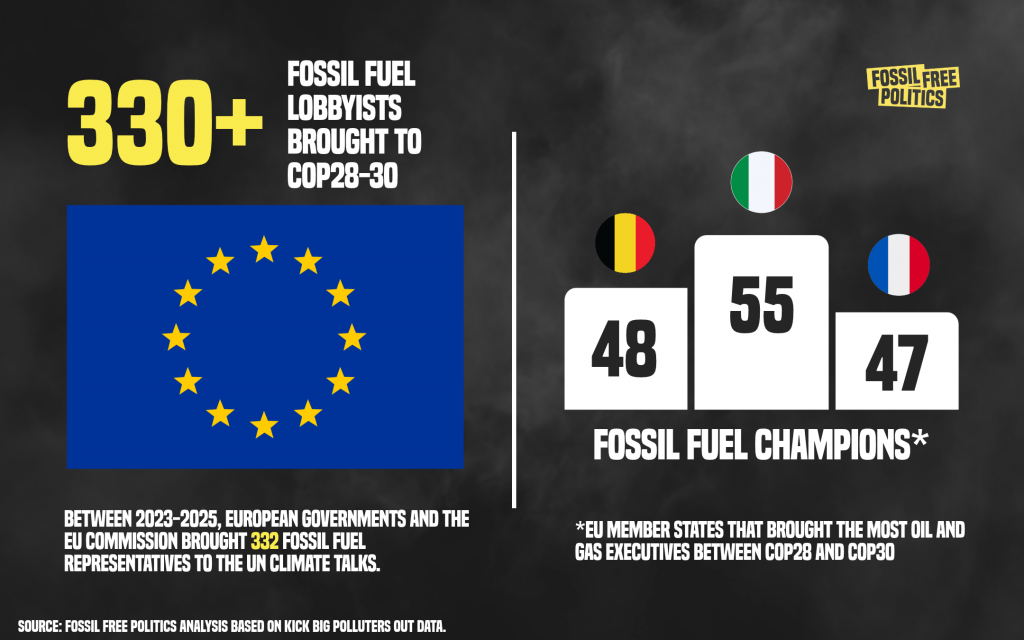
Fossil Free Politics research reveals how between 2023-25, EU member states have included hundreds of top executives from the biggest oil and gas companies in their official delegations to the UN climate change meetings. Between COP28 and COP30, both the European Commission and EU member states between them brought 332 fossil fuel lobbyists on their delegations, giving access to key decision-makers and private negotiating spaces closed off to civil society. At COP29 in Azerbaijan, the invited lobbyists even used the opportunity to sign new gas deals. It would be an absurd contradiction if European governments were to then include them in their delegations to COP31 when they have a track record of derailing climate action.
That’s why Fossil Free Politics has written to European governments demanding they exclude fossil fuel executives from their national delegations; instead they should advocate for a UNFCCC Accountability Framework so that climate negotiations are protected from undue interests; and they should develop a strong EU-level conflict-of-interest rules which protect policy-making from fossil fuel influence.
330+ badges over past 3 years
EU member states and the European Commission have brought in more than 330 fossil fuel representatives from almost 100 different organisations over the previous three years. Between COP28 and COP30, from 2023-25, 15 EU Member State granted 327 places on their delegations to senior executives and staff from some of the most notoriously climate-policy obstructive oil and gas companies. The European Commission granted them 5 places for COP28, but has not allowed them on any subsequent delegation – a trend that Fossil Free Politics hopes will continue.
Pressure pays off
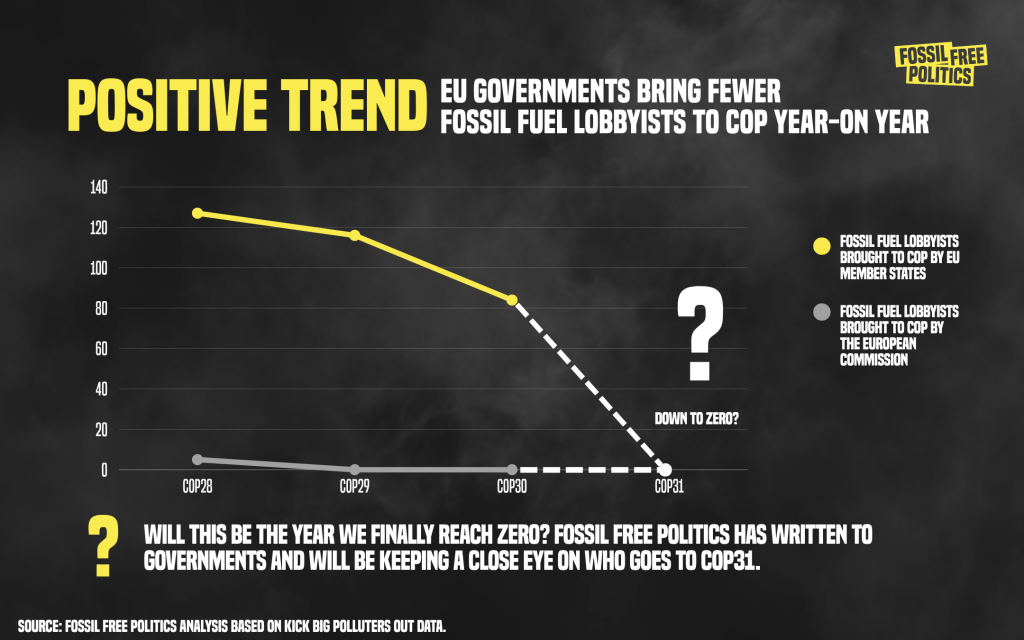
The overall number of fossil fuel lobbyists brought to the talks by EU governments has steadily declined from COP28 to COP30, in part thanks to campaigning from Fossil Free Politics groups in Brussels and across Europe. It was a high of 132 at COP28 in Dubai, dropped to 116 in Azerbaijan, and was 84 last year in Belém, Brazil for COP30.
Box I: Where the data comes from
The data behind the figures in this briefing come from research by the Kick Big Polluters Out coalition, which systematically analyses and classifies all participants at COP and flags those that are considered to be representatives of the fossil fuel industry. For more information on the methodology behind it, please see here.
Between 2023-25, the Fossil Free Politics campaign – also a member of Kick Big Polluters Out coalition – has used the research to produce further analysis on the delegations of the European Commission and the 27 member states. This has been possible thanks to increased transparency of COP attendees, as a result of campaigning by Kick Big Polluters Out groups.
Party overflow badges
Governments, known as ‘parties’ in UNFCCC parlance, have the right to bring whoever they want to the COP. In addition to their official negotiating team, which receive pink ‘party’ badges, they can register lobbyists up until the last minute, who receive pink ‘party overflow’ badges. These permit their holders access to government-only areas. However, prior to COP28, the UNFCCC secretariat did not publish the identities of lobbyists on ‘party overflow’ badges during the COP. Therefore fossil fuel lobbyists brought by the European Commission and its governments had previously flown under the radar. But thanks to the new disclosure measures, the true extent of the problem has been revealed.
Worst offenders: Italy, France, and Belgium
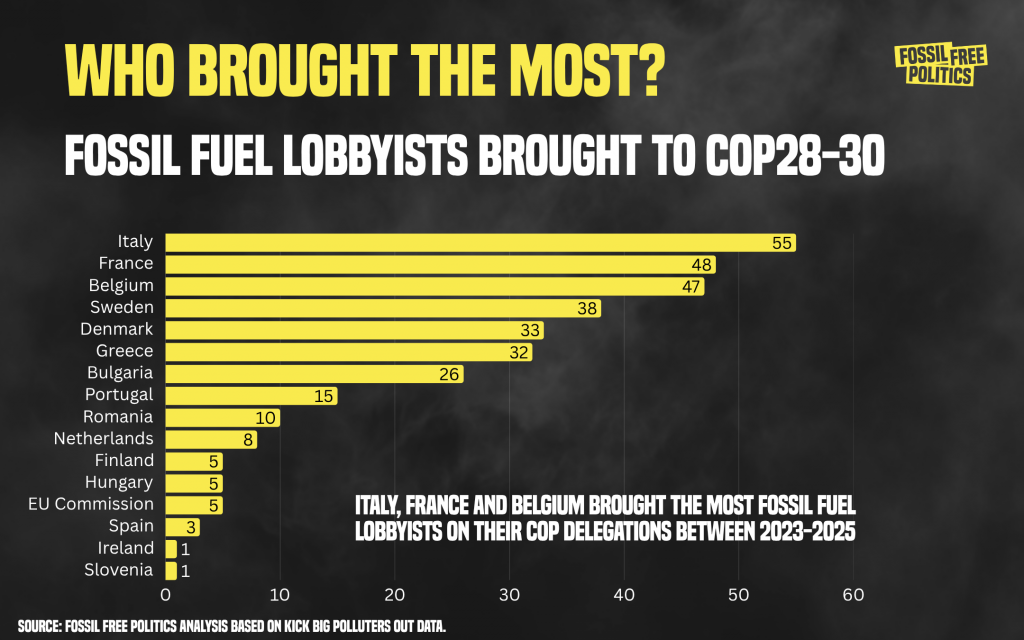
Italy, France, and Belgium handed out the most badges to fossil fuel representatives between COP28-30. Italy topped the charts, bringing 55 lobbyists on its delegation over the three years. France and Belgium each offered nearly 50 badges to fossil fuel lobbyists, while Greece, Denmark, and Sweden each provided more than 30.
Italy consistently brought lobbyists from its national oil and gas major Eni, and at COP29 in Baku it brought numerous senior executives from of gas transporter Italgas, who in turn used the talks to sign the dotted line on a gas distribution deal with SOCAR, the nationally-owned oil company of hosts Azerbaijan.
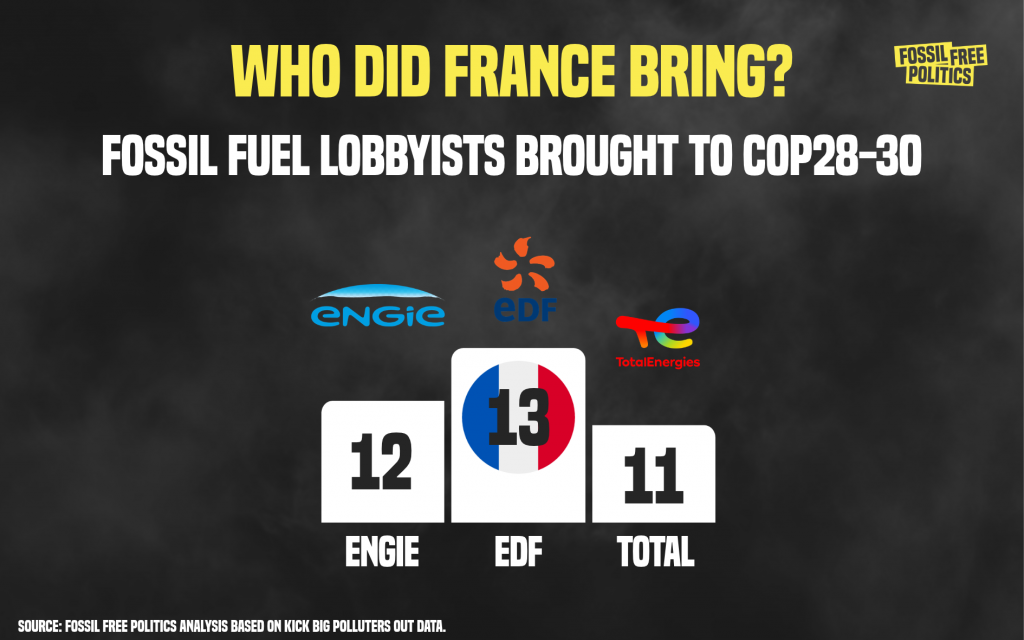
France’s delegation featured notable lobbyists from national utilities EDF (Électricité de France) and ENGIE, as well their own oil and gas major TotalEnergies — twice bringing its CEO Patrick Pouyanné (France boycotted COP29 so had no delegation).
Belgium’s delegation included senior staff from ENGIE, which owns and operates numerous gas and nuclear power plants in the country, as well as Pascal De Buck, CEO of Belgian multinational Fluxys, Europe’s largest gas transporter.
Other countries that offered government badges to fossil fuel lobbyists included Bulgaria, Portugal, Romania, Netherlands, Finland, Hungary, Spain, Ireland, and Slovenia. The European Commission also hosted top fossil fuel lobbyists on its delegation (see below).
European Commission learns its lesson
For COP28 in Dubai, the European Commission brought two of Eni’s top figures, Chief Executive Officer Claudio Descalzi and Chief Operating Officer Natural Resources Guido Brusco, as well as BP Executive Vice President Giulia Chierchia. The Commission also brought Nikolaas Baeckelmans, ExxonMobil’s Vice President of EU Affairs in Brussels, despite the fact the US oil and gas major was actually suing the European Commission at the time for introducing a windfall tax on excess oil and gas profits.
Since then, the European Commission has excluded fossil fuel lobbyists from its official delegation, thanks in part to the sustained campaigning of Fossil Free Politics and others. Facing questions from Members of the European Parliament based on the Fossil Free Politics and Kick Big Polluters Out research, EU Climate Commissioner Wopke Hoekstra, who previously worked for Shell, even expressed support for a conflict-of-interest policy at the UN climate talks. However, since then, no official policy has been put in place to stop either the Commission or member states from bringing fossil fuel lobbyists to UN climate negotiations.
Supersized proportions
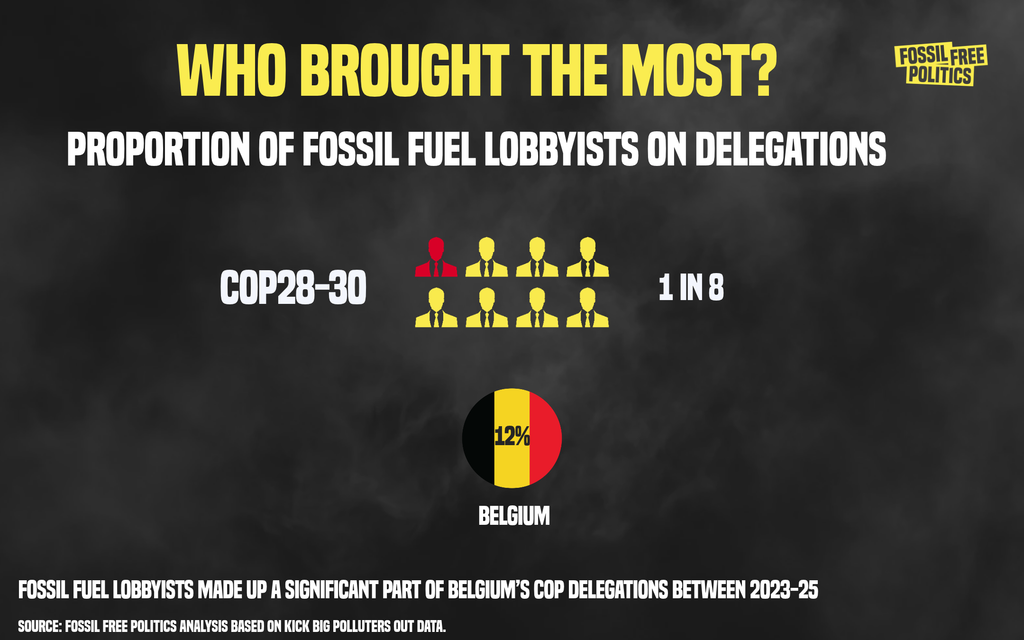
For Belgium in particular, fossil fuel lobbyists represented 12 per cent of their entire delegations from COP28-30. That means that one in every eight people brought to the climate talks by Belgium between 2023-2025 had an economic interest in continuing the fossil fuel economy.
In addition to gas companies ENGIE and Fluxys, Belgium also brought nine staff members from off shore oil and gas rig servicer Jan De Nul, including their CEO.
Sweden turbo charges access
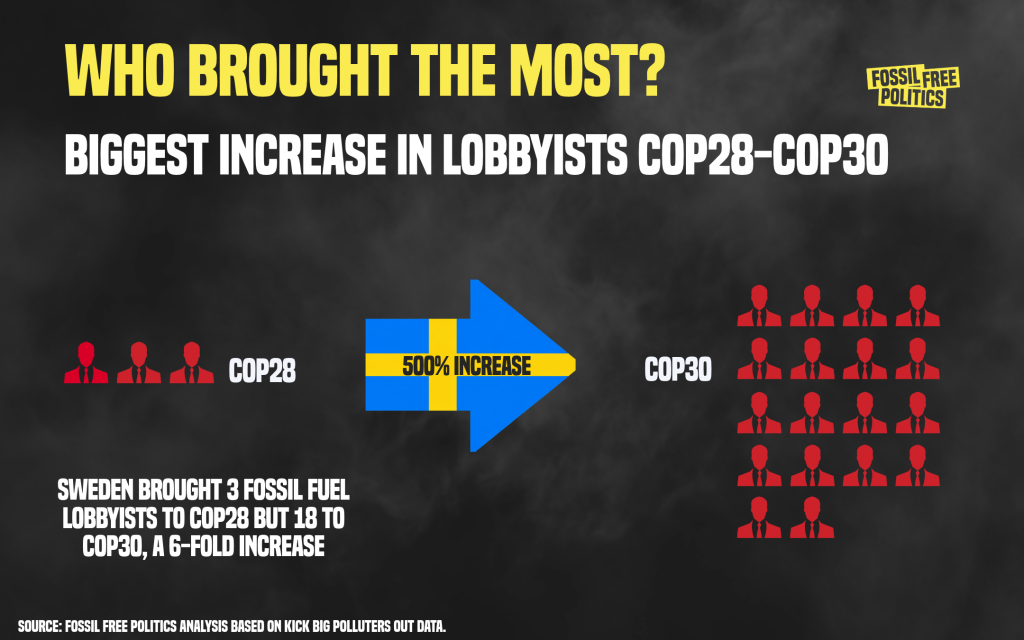
Between COP28 in the United Arab Emirates and COP30 in Brazil, Sweden increased the number of fossil fuel executives it brought into the UN talks six-fold (500 per cent). This included numerous Vice Presidents from E.ON, a German utility with gas-fired power plants in Sweden and across Europe.
Serial offending corporations
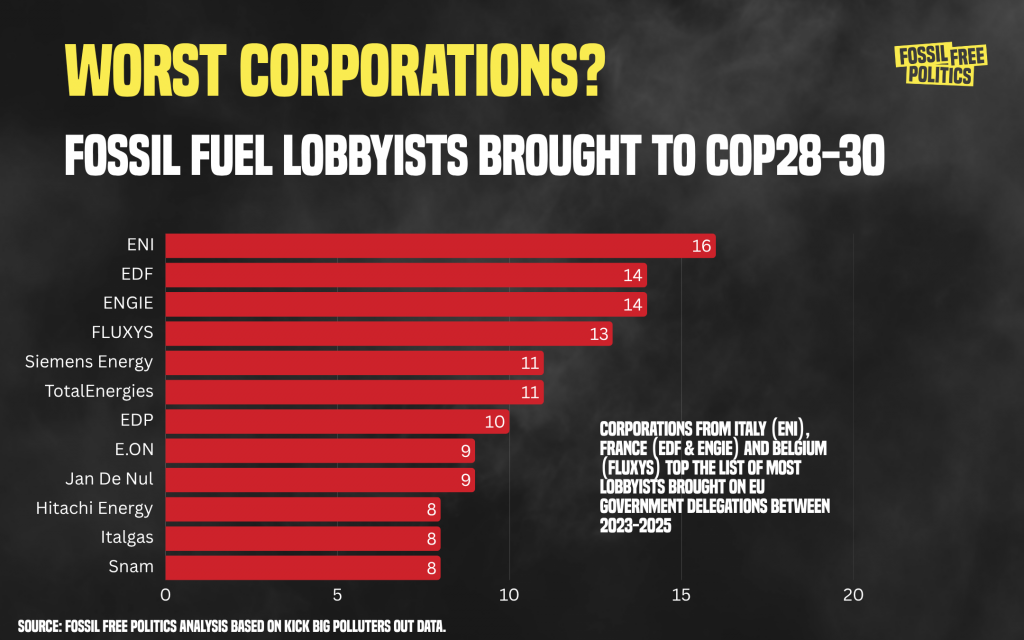
Italian oil giant Eni received a total of 16 badges (14 from Italy and two from the EU Commission). Next up were the French duo EDF and ENGIE, both receiving 14 badges (all from France apart from two Belgian badges given to ENGIE for COP30). Belgium consistently guaranteed the presence of Fluxys, giving it 13 badges over the three years, while TotalEnergies received 11 from France.
Spotlight: Italy ushers in EU policy–obstructor Eni
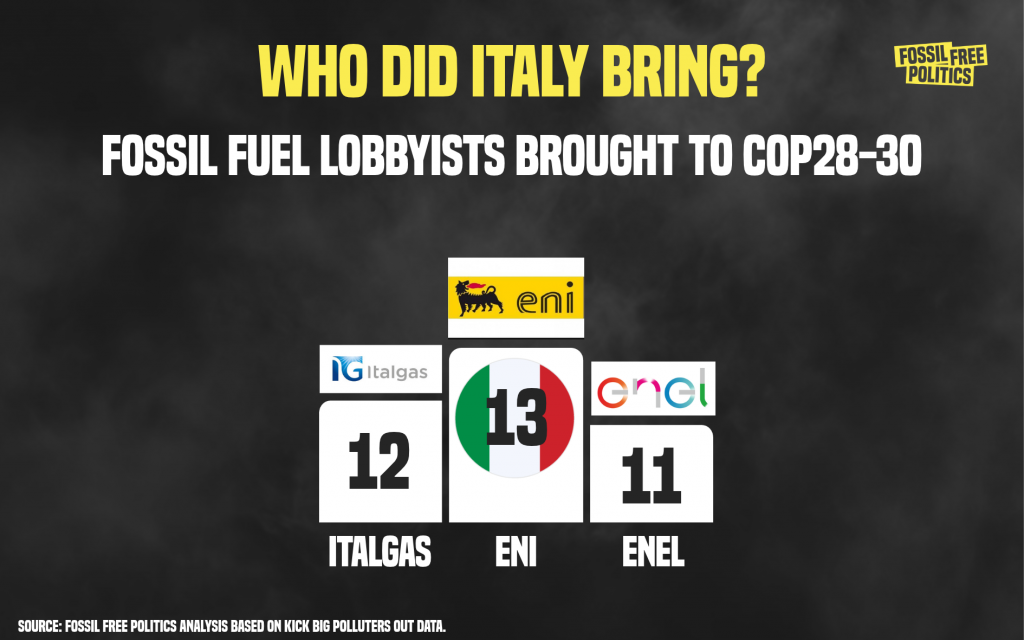
Between COP28 and COP30, Italy gave 14 delegation badges to Eni lobbyists.[1] The Italian oil and gas major is one of the most influential in Europe when it comes to energy policies, in part thanks to its close ties to the Italian government.
Publicly, Eni is supportive of the need to reduce methane emissions. But the gas giant has leadership positions on both the IOGP and Eurogas, two prominent fossil fuel industry lobby organisations that have aggressively lobbied to weaken the EU Methane Regulation (EUMR). The Regulation was adopted in August 2024 in an effort to help curb fossil fuel methane emissions. Eni’s lobbyists attended two meetings with the European Commission between January 2025 and July 2026 on these regulations, and Eni was part of an industry effort in April 2026 to try to further weaken the regulations. Following the industry campaign, the European Commission has now proposed a one-year delay to the implementation rules, while the European Parliament just voted to delay implementation until 2030.
More broadly, Eni repeatedly advocates for scenarios and policies that would ensure oil and gas continues being used in energy projections well into the future, and received one of the lowest climate policy engagement scores from InfluenceMap (D+). Eni is very supportive of carbon capture and storage (CCS) and hydrogen — risky and controversial technologies that are being positioned as climate “solutions” while providing life support to the fossil fuel industry.
Beyond embedding fossil fuels further into the energy transition, Eni is also partnering with Big Tech to fuel their data centres. For example, it has partnered with AI firm MGX to power data centres in Italy with Eni’s “blue power”, but this supposedly eco-friendly energy source is coming from gas-fired power plants with CCS. As ReCommon has shown, the associated CO2 pipelines would run through earthquake-prone areas and shift significant risk onto local communities. Calling this new form of fossil fuel dependence “blue” doesn’t make it green, and it is anything but. Europe’s attempts to expand risky CCS have failed to capture or store CO2 at any meaningful scale while risking great harm.
During COP29, Italy’s delegation included Eni Senior Vice President Marco Piredda and Public Affairs Director Lapo Pistelli. Eni’s CEO Claudio Descalzi was also a guest of the COP29 Azerbaijani presidency, and three of its senior staff attended as part of the International Chamber of Commerce delegation. At COP28, two Eni lobbyists were on the European Commission Party overflow.
Spotlight: France’s COP courtship with ENGIE and TotalEnergies
Between COP28 and COP30, France’s delegation included 48 badges for industry lobbyists — the second largest number from EU Member States in this period. This included 12 badges for ENGIE, a French energy company with an extensive fossil gas and liquefied natural gas (LNG) portfolio. France also gave 11 badges to TotalEnergies, a French oil and gas major operating across well over 100 countries.
ENGIE: Hosting Brussels climate week with one hand while undermining EU climate regulation with the other
ENGIE brands itself as a “leader in the energy transition.” Its planet-friendly PR is illustrated by its sponsorship of the first Brussels Climate Week which took place in October 2026, right ahead of COP31 in Antalya. But at present, most of ENGIE’s energy is still provided by gas-fired power plants. Its non-renewable energy (including gas, coal and nuclear), still makes up 45% of its energy transition projections, and it has invested at least €258 million to expand its gas production. ENGIE remains one of Europe’s largest importers of liquified natural gas (LNG) — which generates 1/3 more emissions than coal.
ENGIE’s lobbying activities further demonstrate its commitment to profit over planet. Its lobbyists have worked hard to stall and thwart the EU Methane Regulations (EUMR). It directly lobbied for weaker emissions measurement requirements and joined efforts to stymy the rolling out of the regulations.
According to Lobbyfacts EU, ENGIE spent up to €2.25 million on EU lobbying each year between COP28 in 2023 and COP30 in 2025 and has declared 8 lobbyists in Brussels. Thanks to its wealth of resources, it secured 47 high-level meetings with EU Commission top brass between 2023 and October 2026.
Despite ENGIE’s carefully crafted green exterior, it is clear that a major objective is ensuring a future that keeps fossil fuels front and centre.
TotalEnergies: Lobbying for Paris (Dis)Agreement
French gas major TotalEnergies has made a concerted effort to undermine the EU Methane Regulation (EUMR). Between January 2025 and July 2026, it had a dozen registered meetings with the Commission to discuss the regulations — more than other major multinational fossil fuel corporations, according to Fossil Free Politics. In the months prior to a letter from 17 Members of European Parliament advocating for weaker measures in the EUMR, TotalEnergies lobbyists had meetings with some of the letter’s signatories. TotalEnergies sits on the board of three of the prominent oil and gas industry organisations that have also opposed the EUMR — namely International Association of Oil and Gas Producers (IOGP) Europe, Eurogas and Energy Traders Europe.
TotalEnergies continues to meet with high-level Commission staff about methane regulations, with one registered as recently as October 6, 2026. TotalEnergies declared had a lobbying budget of up to €3.5 million annually between COP28 and COP30. It employed 9 lobbyists to engage the EU on its priorities and held 93 high-level EU meetings between 2023 and October 2026.
TotalEnergies’ public communications portray support for the Paris Agreement and climate action, but its actions paint a very different picture. As recently as March 2026, CEO Patrick Pouyanné implied that the 1.5 degrees Celsius target is not possible. The company has previously questioned science-aligned scenarios from the Intergovernmental Panel on Climate Change (IPCC). Its objectives are clearly summarised in a 2025 correspondence to the UK Government in which it stresses that oil and gas production should be maximised.
TotalEnergies is the EU and UK’s largest LNG importer by a long stretch, a move that “risks French and European security, energy affordability, and climate goals”, according to Oil Change International.
Though the French Government boycotted COP29, TotalEnergies still sent six lobbyists to Baku. Vice Presidents, Managing Directors other senior staff were brought into the talks by their trade associations Association Française des Entreprises pour l’Environnement, BusinessEurope and the International Emissions Trading Association (IETA). CEO Pouyanné there as a guest of the Azerbaijani Presidency.
Box II: Slow but steady progress towards kicking big polluters out of the climate talks
Following years of sustained campaigning by the Kick Big Polluters Out coalition (including Fossil Free Politics), the UNFCCC finally took its first (baby) steps on transparency in the run-up to COP28: all UNFCCC participants are now expected to publicly declare their affiliation. In addition, Party overflow badges became public for the first time (see data box). This brought to light many of the fossil fuel interests that were previously hidden, as well as which governments were granting them access.
Ahead of COP30, the UNFCCC again responded to pressure to take additional steps. All non-government delegates are now asked to disclose who is funding their participation and confirm that their objectives are aligned with those of the UNFCCC. However, it is a major oversight that this measure does not apply to those on government delegations, meaning all those covered in this report would not face disclosure requirements.
These small steps have been long overdue, but are entirely insufficient when it comes to addressing fossil fuel influence over climate policy-making. This is why civil society has been calling on the EU and all Parties to the UNFCCC, as well as the UNFCCC Secretariat, to advance an Accountability Framework and conflict of interest measures that will end the ability of Big Polluters to write the rules of climate action.
EU must not bring fossil fuel lobbyists to COP31
As COP31 begins on Europe’s doorstep in Antalya, amidst a backdrop of an energy crisis fuelled by Europe’s fossil fuel addiction, the EU has a choice. Does it continue to facilitate fossil fuel industry access the talks, whose main interest is weakening climate action? Or does it put the interests of European households and businesses first, as well as those countries and communities across the Global South that are the least responsible for the climate crisis?
The European Commission and EU Member States together brought more than 330 fossil fuel representatives to the UN climate talks between COP28 and COP30. This is an unacceptable figure. However, over that period we also witnessed a steady year-on-year decline, from 132 in Baku at COP28 to 84 in Belém at COP30. COP31 now needs to ensure that decline continues and there are zero fossil fuel executives included in EU delegations. Fossil Free Politics members have written to the worst offending governments (Italy, France, and Belgium), as well as the European Commission, calling on them to not bring fossil fuel lobbyists to COP31 in Türkiye. They will be watching closely at what happens. In the letters they called on governments to:
a) Not grant UN climate summit accreditation (including overflow badges) to fossil fuel lobbyists or executives and exclude them from their national delegation to COP30 and future talks — building on the European Commission’s positive example at COP29 and COP30.
b) Advocate for a UNFCCC Accountability Framework to shield negotiations from undue influence, including robust conflict-of-interest disclosure rules for all participants, building on the general agreement expressed by many Parties during the “Open Dialogue on Enhancing transparency of participation and integrity in the UNFCCC process” during SB64 for the need to address conflicts of interest.
c) Develop a robust EU-level conflict of interest policy to shield public policymaking from fossil fuel interference, aligning European governance with the ambition and urgency of its climate goals.
Both within and beyond its borders, the EU has an obligation to ensure that climate policy is protected from, not written by, the fossil fuel actors that have simultaneously orchestrated and profited from the climate and energy crises.
At COP31, EU governments should exclude the fossil fuel industry from their delegations, but it is far from sure. Will we see a break with the past or business as usual?
[1] This is in addition to the two badges from the European Commission Eni received for COP28.