Home » Hoeskstra and EU told to leave lobbyists at home for COP31
Hoeskstra and EU told to leave lobbyists at home for COP31
As governments gear up for COP31 in Antalya, Türkiye, Fossil Free Politics and its member groups have written to EU governments telling them to exclude the fossil fuel industry from their official delegations.
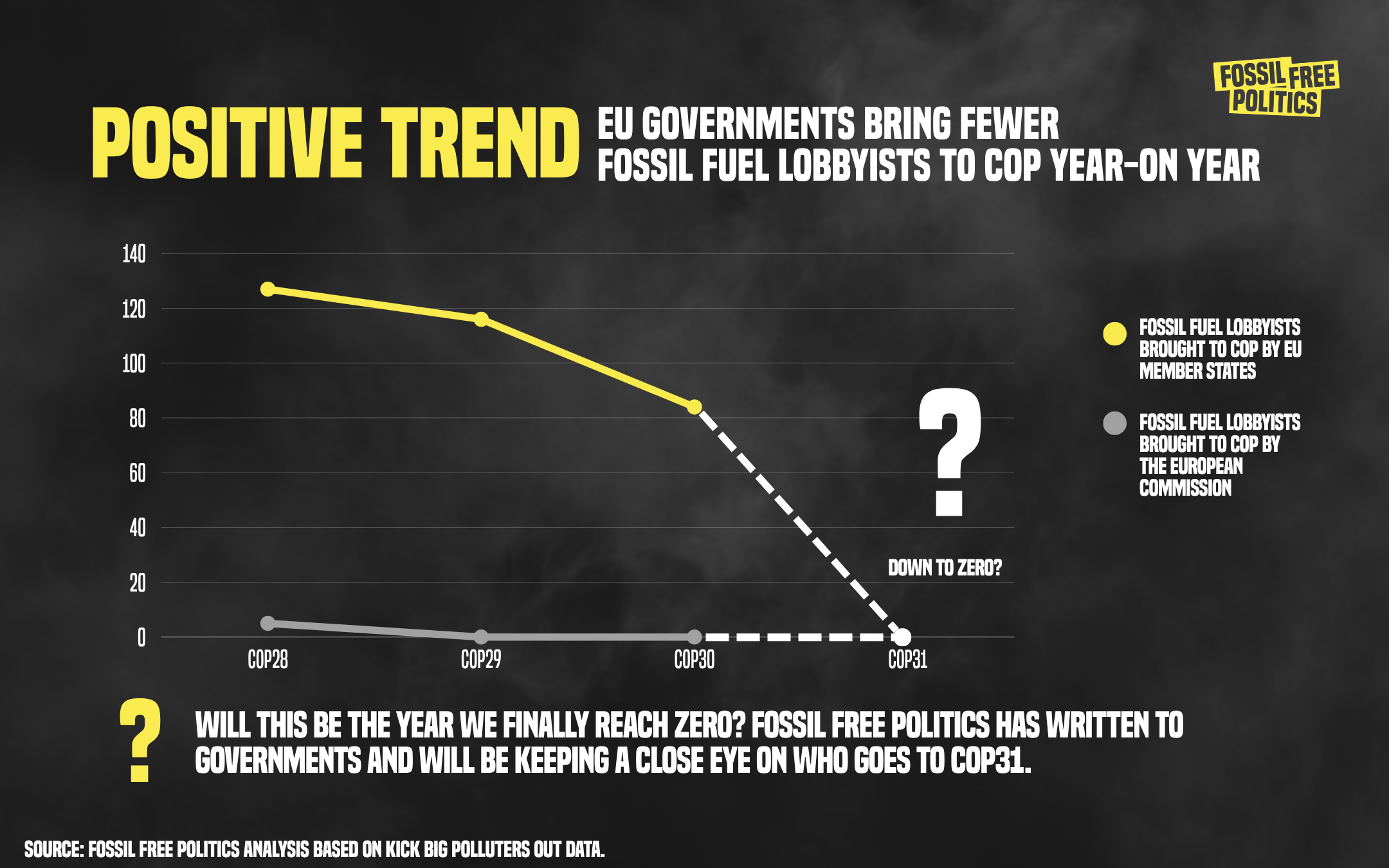
This follows revelations that the European Commission and EU Member States have brought more than 330 lobbyists on their delegations to the previous three COPs (2023-2025).
See below the letter sent to EU Climate Commissioner Wopke Hoekstra by the Fossil Free Politics campaign, Climate Reality Project Europe and Transparency International Europe.
To: European Climate Commissioner Wopke Hoekstra
CC: European Commission President Ursula von der Leyen
CC: European Commissioner Teresa Ribera
Dear European Climate Commissioner Wopke Hoekstra,
Subject: Maintaining EU Climate Leadership at COP31
We are writing to you on the eve of COP31 in Türkiye, building on last year’s correspondence expressing our concerns about fossil fuel interference in the UN climate process. Unfortunately, those concerns remain as urgent as ever.
Europe’s negotiators will likely be heading to Antalya in the midst of a prolonged energy crisis, even if the Strait of Hormuz is fully reopened. The cost of Europe’s exposure to fossil fuels has been exposed once more, with the price being borne through rising energy bills as others profit. The six largest oil and gas companies registered profits reaching $80 billion in the second quarter of this year as a result of the US-Israeli conflict. In the third quarter Shell forecasts its refineries to almost double the profit earned on each barrel compared to the previous quarter.
While the EU states its determination to move away from fossil fuels, the industry’s clear commercial incentive sees it lobbying to maintain dependence. The same pattern appears at the UN climate talks: one in every 25 participants at COP30 in Belém was a fossil fuel lobbyist, according to research by the Kick Big Polluters Out coalition. They significantly outnumbered all country delegations, bar the host Brazil. This pattern of privileged access undermines public trust and the integrity of climate and energy decision-making.
COP31 comes at an intensely difficult moment for international cooperation, but represents a pivotal moment to further the goals agreed under the Paris Agreement. In Antalya, the European Union can demonstrate genuine climate leadership not only by championing a rapid phase-out of fossil fuels to keep the 1.5°C limit within reach, but also by ensuring fossil fuel interests do not block or weaken that transition. As the recent UNEP report ‘Limiting Overshoot’ makes clear, every fraction of a degree avoided will save lives, protect ecosystems and reduce economic losses.
As outlined by European Commission President Ursula von der Leyen in her State of the Union address, this summer’s record heat waves provide a renewed sense of urgency in addressing the transition. Soaring temperatures saw more than 16,000 heat-related deaths in Germany alone. This is not an unexplainable event but the direct result of decades of delay and obstruction by those profiting from fossil fuels.
As long-time observers of the UN process, we commend your decision as European Commissioner for Climate to exclude fossil fuel executives from the official EU delegation for COP30, building on the example you set at COP29. However, EU Member States still included more than 80 fossil fuel lobbyists in their national delegations.
New research by the Fossil Free Politics campaign reveals that over the past three years the European Commission and Member State governments have brought more than three hundred and thirty fossil fuel executives to the UN climate talks, there to secure their polluting business models. Italy was the worst offender, bringing 55 over the past three years, while France brought 48 and Belgium 47.
If the EU is serious about leading the transition away from fossil fuels, it must act decisively to curb the industry’s undue influence at COP31 and beyond.
To protect the integrity of climate policymaking—both within the EU and globally—we urge you to take the following actions:
Do not grant UN climate summit accreditation (including overflow badges) to fossil fuel lobbyists or executives, and exclude them from the European Commission’s delegation to COP31 and future talks—building on your own positive example at COP30 and COP29. Encourage Member States to do the same. Only by keeping vested interests out can the EU restore credibility and lead with integrity.
Advocate for an UNFCCC Accountability Framework to safeguard negotiations from undue influence, building on precedents like Article 5.3 of the WHO Framework Convention on Tobacco Control. This should build on the general agreement expressed by many Parties during the “Open Dialogue on Enhancing transparency of participation and integrity in the UNFCCC process” at SB64 of the need to address conflicts of interest.
Develop a robust EU-level conflict of interest policy to shield public policymaking from fossil fuel interference, aligning European governance with the ambition and urgency of its climate goals.
The Fossil Free Politics coalition, representing over 200 organisations across Europe and the world, will monitor the presence and influence of fossil fuel lobbyists at COP31. We look forward to following up with your cabinet after the summit to discuss progress on these critical issues.
At this defining moment, Europe must rise to the challenge. Real climate leadership means standing up to those who profit from delay and ensuring that climate policy serves people and the planet, not polluters.
Yours sincerely,
Nathan Stewart, Fossil Free Politics coordinator On behalf of Fossil Free Politics, The Climate Reality Project Europe and Transparency International EU
You can download the pdf here, which includes all sources and references.
Fossil Free Politics national members also wrote to Ministers in the three worst offending countries:
We will be paying close attention to the European Commission and the worst offending countries to see whether they bring fossil fuel lobbyists to COP31 or not.