
and EU media shouldn’t help them do it!
The fossil fuel industry knows a good opportunity when it sees one. And the US-Israeli war on Iran and further escalation in the region has been a major opportunity for them.
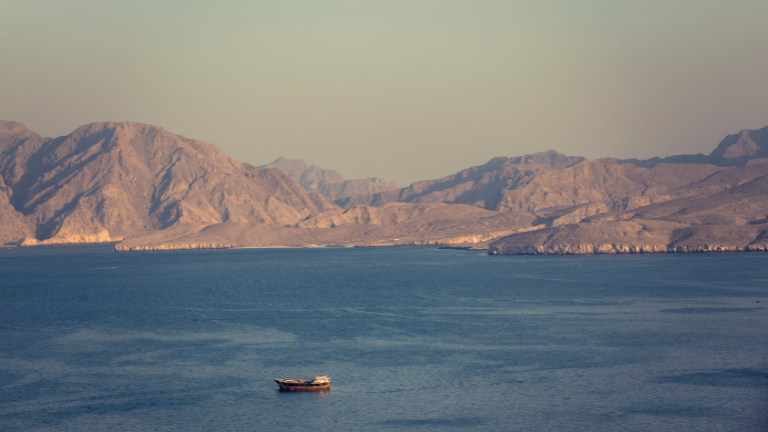
Attacks on key infrastructure earlier this year and Iran’s subsequent blockade of shipping routes through the Strait of Hormuz severely disrupted the supply of the world’s oil and gas.
Indeed, this near-closure of a key waterway removed close to 20% of global liquefied natural gas (LNG) supply from the market almost overnight, and it’s not an exaggeration to say that its constant opening and closure in the months since has brought uncertainty and disruption to the entire planet.
Yet powerful corporate interests have moved quickly to maximise their profits at the expense of everyday people, with the top 100 oil and gas producers in the world estimated to profited more than $30 million every hour during the first month of the war alone.
All while the European Commission itself said that “Europeans are paying the price of Europe’s dependency on imported fossil fuels.” This goes to show just how structurally dependent Europe is on imported fossil fuels.
If a single conflict can leave millions of Europeans paying higher energy bills while fossil fuel corporations record profits, something is fundamentally wrong with our energy system. But rather than treating this war as evidence that Europe must accelerate its transition away from imported oil and gas, some of the world’s largest fossil fuel corporations are using it to stoke fears about energy security to push their own agenda.
We have seen this before.
Following Russia’s invasion of Ukraine in 2022, energy prices surged and households across Europe struggled to make ends meet. Meanwhile, fossil fuel companies reported nearly $200 billion in profits as U.S.-based firms pocketed the largest share.
Access to decision-makers became increasingly skewed, with a dramatic increase in meetings between senior European Commission officials and fossil fuel representatives right after the invasion, raising serious questions about whose interests were shaping Europe’s response.
History repeating itself
US fossil fuel companies are again actively exploiting fears about energy security to undermine European climate and environmental legislation. Their latest target is the EU Methane Regulation, the world’s first comprehensive framework aimed at reducing methane emissions from the energy sector.
If enacted properly, it would require companies to fix leaks, improve supply chains, and end ridiculously wasteful practices like “flaring” where they literally burn off excess gas The problem is that the industry sees it as a threat to its profits.
To make this supposed threat clear, American energy giant Exxon Mobil recently paid 31,500 EUR for a single sponsored article in Politico Europe, entitled “The looming crisis putting Europe’s energy security at risk”.
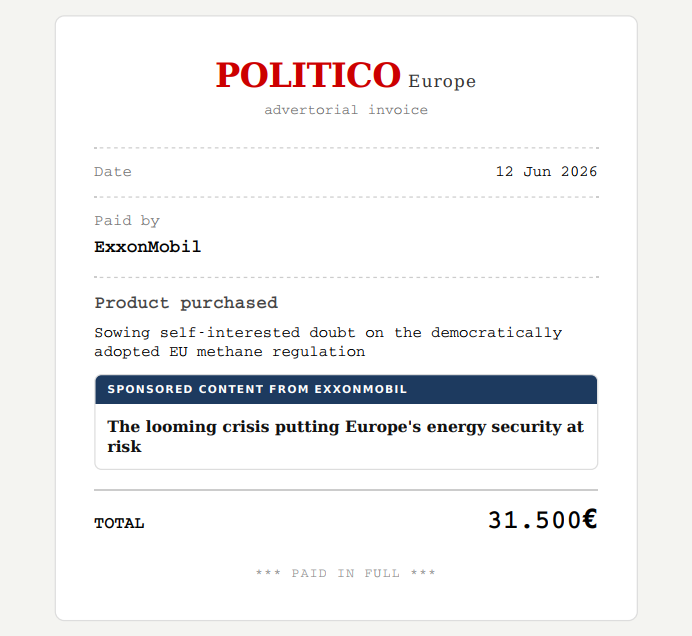
Presented to the reader as a regular opinion article, save for a few disclaimers, the advert claims consumers will “bear the burden of higher gas and/or fuel prices” if the implementation of the regulation proceeded.
The timing was no coincidence. As the war on Iran fuels concerns about energy security, Exxon Mobil is seeking to leverage those fears to weaken rules that could affect its bottom line. It has since been pointed out that the advert was an attempt to shape public debate and influence legislation using false claims by exploiting a moment of geopolitical uncertainty.
But sponsored content is only one part of a much broader influence ecosystem and influence playbook, combining sponsored content like this with lobbying events under the guise of debates and dinners. These events provide opportunities for direct matchmaking between high-level politicians and industry leaders while civil society organisations, trade unions and communities facing energy poverty don’t get a look in.
So when media outlets like Politico accept sponsorship from companies with a direct financial stake in climate and energy legislation, the line between journalism, lobbying and influence is even more blurred.
Fossil fuel companies can’t make the rules
Europe cannot achieve genuine energy security while remaining dependent on imported fossil fuels whose supply can be disrupted by conflicts abroad. Nor can we claim to have fully independent democratic institutions when powerful foreign corporations are granted extraordinary influence over the very policies designed to regulate them.
Promoting misinformation is Exxon Mobil’s bread and butter, but we shouldn’t grow cynical in the face of such dangerous attacks on our decision-making.
Fossil Free Politics calls for limiting fossil fuel industry access to decision-makers, and for governments, politicians and civil society to reject partnerships with the fossil fuel industry.
To this end, we recently launched a new pledge for MEPs to sign, with signatories promising to only interact with the fossil fuel industry only when and to the extent strictly necessary. However, relying on the integrity of individual members and Commission staff is not going to cut it.
We need stricter lobbying rules, greater scrutiny of sponsored political influence and stronger protections against conflicts of interest for the fossil fuel industry.
War should not be a business opportunity. But while these companies are allowed in the room, and promoted in our media, it will be. There can be no lasting peace in a fossil fuel economy.
We need to put the people at the centre of our decision-making, not the fossil fuel companies. We need fossil free politics!